
The 2nd International Conference on Computer Vision and Augmented Reality (CVAR 2026) Successfully Concluded in Changsha
On March 28, 2026, the 2nd International Conference on Computer Vision and Augmented Reality (CVAR 2026) was successfully held in Changsha. The conference was organized by Zhengzhou University and hosted by the School of Electrical and Information Engineering of Zhengzhou University and the Hunan Provincial Talent Group. The event brought together experts and scholars from home and abroad to engage in in-depth exchanges and discussions on cutting-edge topics including big data and computer vision, image processing and enhancement, transfer learning, real-time environment sensing, human-computer interaction, and immersive experience design.
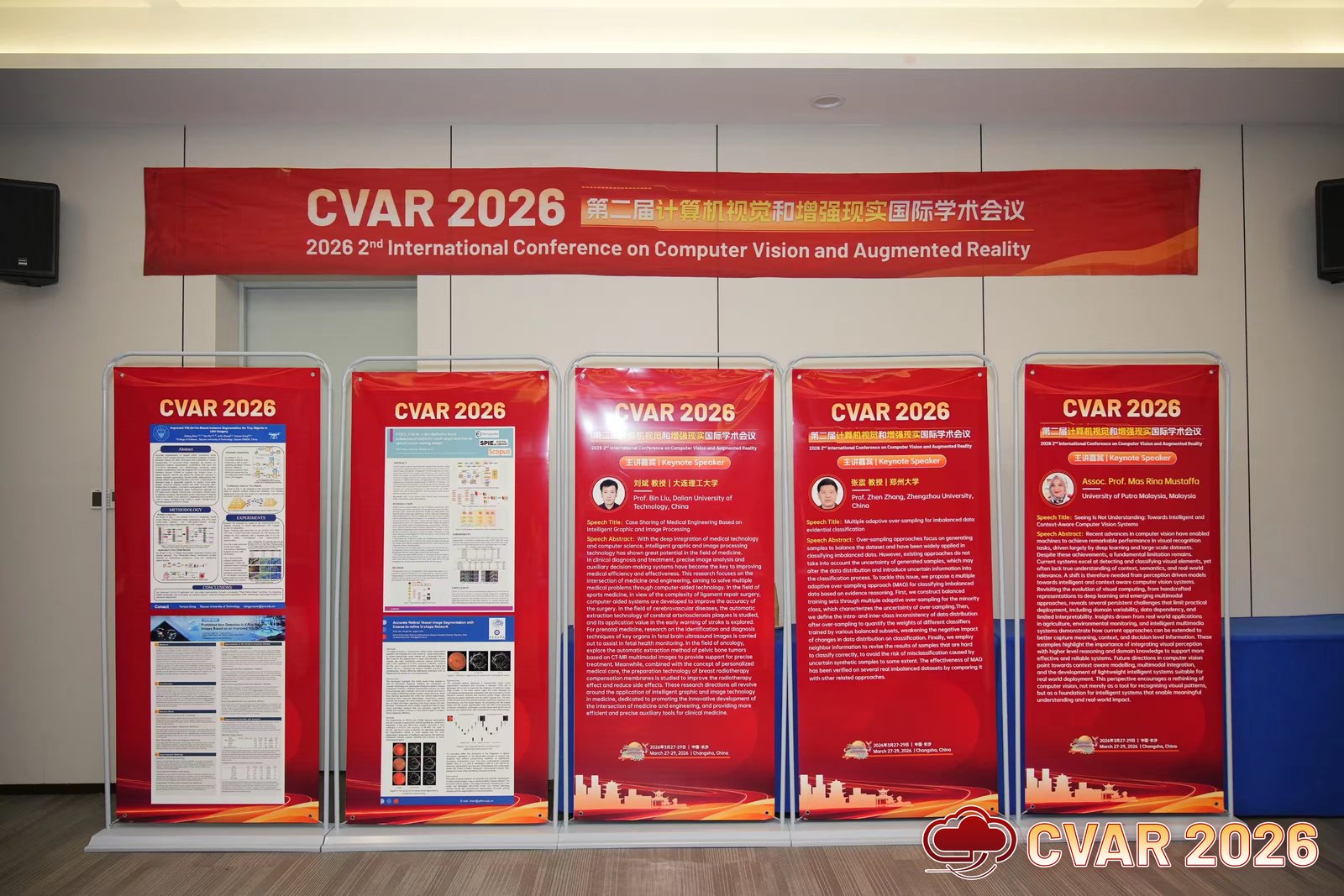
The conference officially opened at the Minxue Hall, 1st Floor, Hunan Provincial Talent Group Training Base. The keynote speech session was highly impressive. Professor Zhen Zhang from Zhengzhou University delivered a talk entitled "Multiple Adaptive Over-Sampling for Imbalanced Data Evidential Classification," addressing the uncertainty of synthetic samples in over-sampling methods. He proposed a multiple adaptive over-sampling framework that effectively improves the robustness of imbalanced data classification through strategies such as constructing balanced training sets, quantifying classifier weights, and revising results with neighbor information. Professor Bin Liu from Dalian University of Technology presented on "Case Sharing of Medical Engineering Based on Intelligent Graphic and Image Processing," sharing innovative applications of intelligent graphic and image technologies in medicine, covering areas including sports medicine-assisted surgical systems, automatic extraction of cerebral atherosclerotic plaques, fetal brain ultrasound image recognition, CT-MR multimodal image-based tumor extraction, and breast radiotherapy compensator preparation. Associate Professor Mas Rina Mustaffa from the University of Putra Malaysia, Malaysia, delivered a talk entitled "Seeing Is Not Understanding: Towards Intelligent and Context-Aware Computer Vision Systems," pointing out the limitations of current vision systems in semantic understanding and context awareness, and envisioning future directions in multimodal integration and lightweight intelligent systems. The three speakers offered forward-looking academic insights from the perspectives of theoretical methods, medical-engineering integration, and system architecture.
Prof. Zhen Zhang, Zhengzhou University, China Title:Multiple adaptive over-sampling for imbalanced data evidential classification |
Prof. Bin Liu, Dalian University of Technology, China Title:Case Sharing of Medical Engineering Based on Intelligent Graphic and Image Processing |
Assoc. Prof. Mas Rina Mustaffa University of Putra Malaysia, Malaysia Title:Seeing Is Not Understanding: Towards Intelligent and Context-Aware Computer Vision Systems |


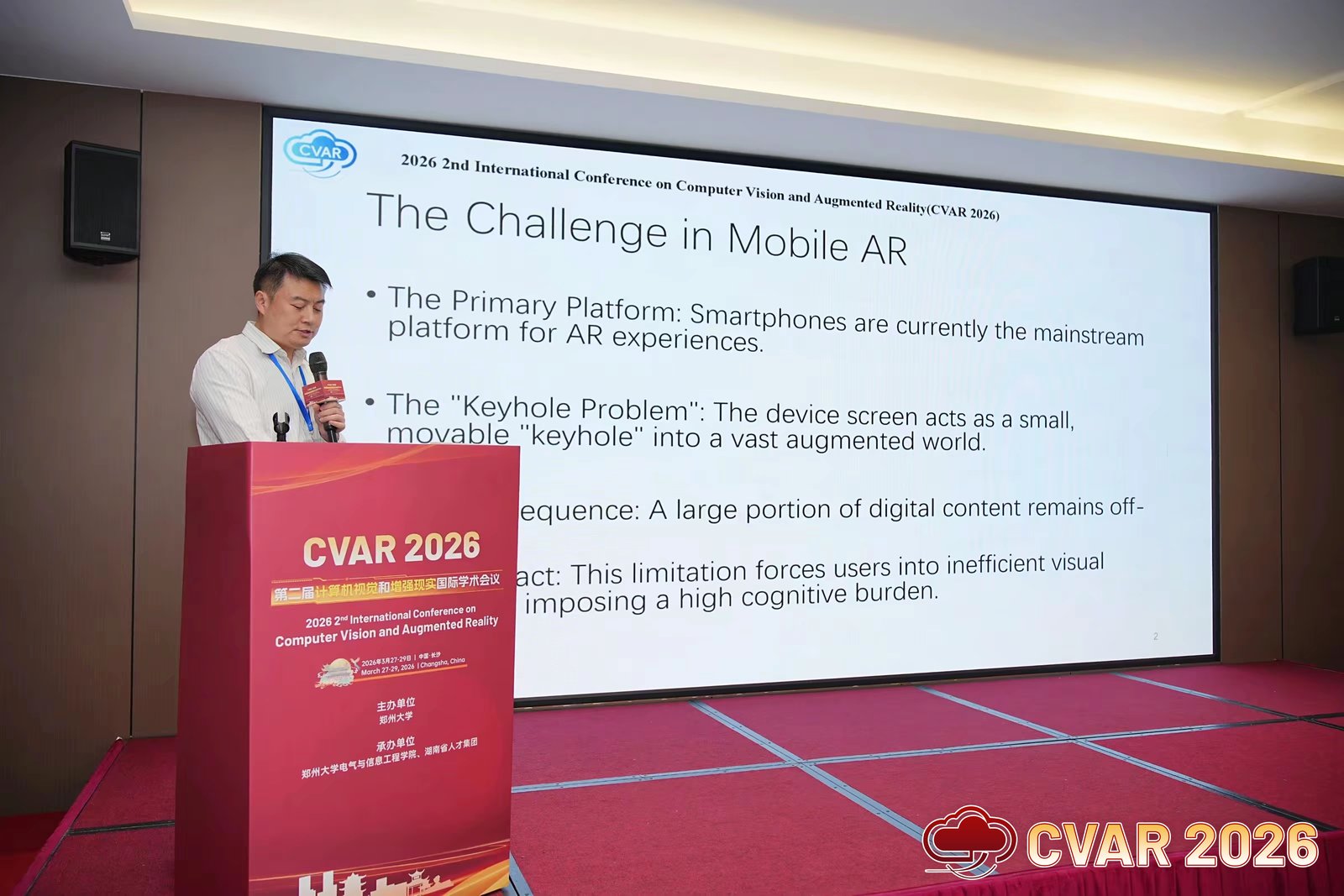
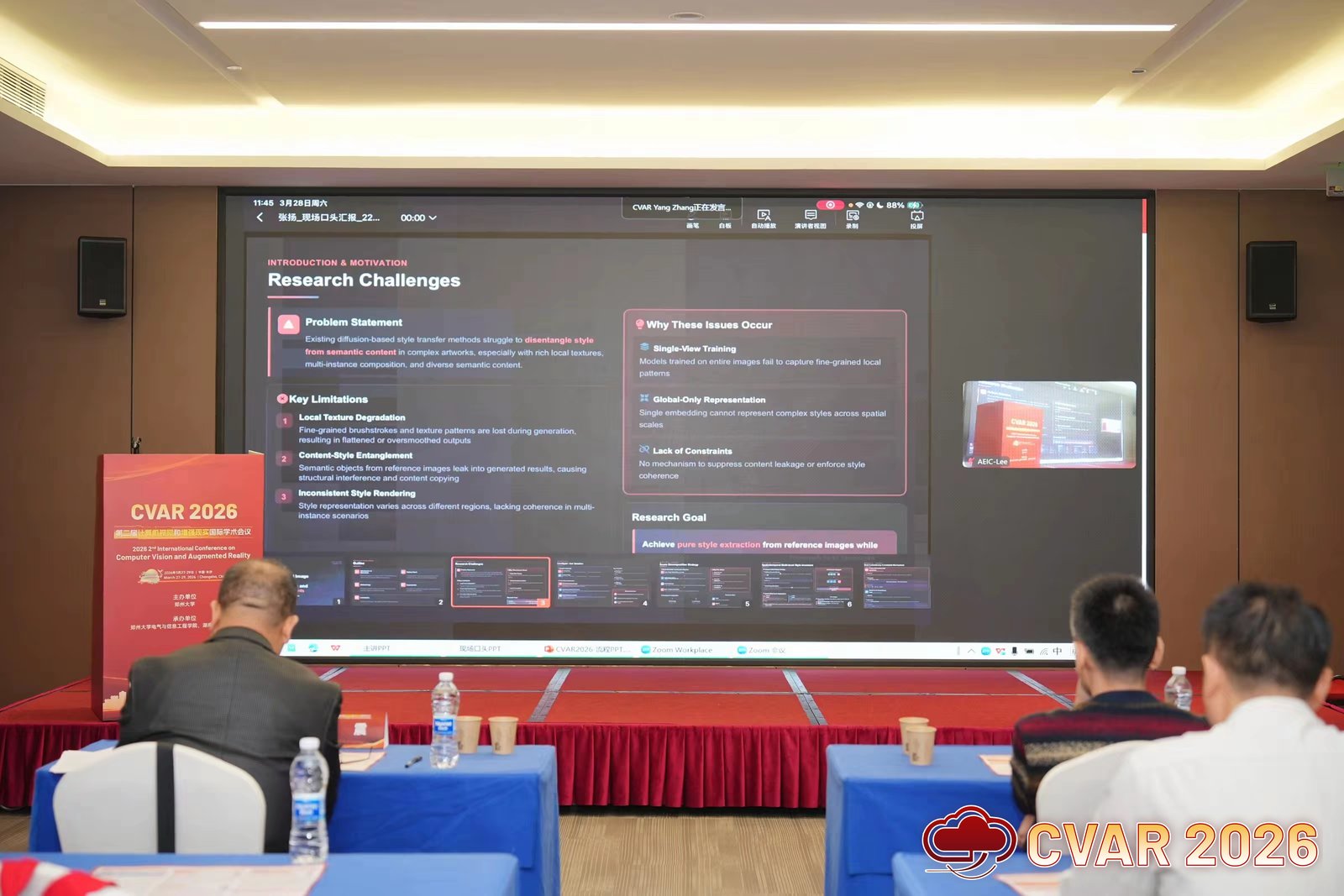
In the oral presentation session, four young scholars—Ruoxu Xiao from the University of Nottingham Ningbo China, Qimo Zhang from Guangzhou Vocational University of Science and Technology, and Yang Zhang from Hefei University of Technology—presented their latest research findings on cutting-edge topics including DeepLabv3+-based image semantic segmentation optimization, monocular 3D object detection, off-screen object visualization in mobile augmented reality, and text-driven stylized image generation, fully demonstrating the innovative vitality and academic potential of young researchers.
Ruoxu Xiao, University of Nottingham Ningbo China Title:Monocular 3D Object Detection Based on Fusion of Dual-Target Bounding Boxes and Relative Positions |
Qimo Zhang, Guangzhou Vocational University of Science Technology Title:A Hybrid Approach to Off-Screen Object Visualization and User Behavior Mapping in Mobile Augmented Reality: A Comprehensive Study on Adaptive Cues and In-Situ Analytics |
Yang Zhang, Hefei University of Technology Title:Text-Driven Stylized Image Generation via Scene Decomposition and Consistency Constraints |

With the collective efforts of all parties involved, CVAR 2026 achieved great success, fully showcasing the latest research outcomes and cutting-edge technologies in the fields of computer vision and augmented reality, and facilitating the exchange and collision of academic ideas. Looking ahead, we look forward to welcoming more outstanding scholars, experts, and young talents to join us in advancing innovation in computer vision and augmented reality, breaking through technological bottlenecks, and contributing to technological progress and industrial upgrading.
We look forward to meeting you again at CVAR 2027!